
Old Gilchrist Hall (1882)
Five years after its founding in 1876, the Iowa State Normal School (now the University of Northern Iowa) had outgrown Central Hall, the original building ISNS inherited from the Orphans Home. The Students’ Offering student newspaper noted in February 1881 that "We are crowded for room, and thus we are put to many inconveniences…." The writer noted students hoped the Iowa General Assembly would fund a new building. Bills had been introduced in both 1878 and 1880 without success.
On March 11, 1882, students and faculty learned both houses of the legislature had passed an appropriations bill which included $30,000 for a new building. Students held a mass meeting and planned a campus-wide celebration including a torchlight parade and music by the Cedar Falls Coronet Bend, although bad weather forced cancellation of the outdoor plans. The March 1882 student newspaper published a long article on the significance of a new building. For the first 15 years of the Normal School’s history, its continued existence was determined year by year. There was no continuing appropriation for the school, and its budget was built at each session of the general assembly. Some legislators believed a public school for training teachers was unnecessary, while others wanted the state to organize additional normal schools. Funding for a second building in Cedar Falls appeared to indicate support for the institution.
Officials hoped contracts for the new building would be awarded quickly, with construction to begin in spring 1882. The target date for completion was fall 1883. As school concluded in June 1882, the Class of 1882 was already putting together material to be included in the cornerstone of the new building.
At their March 30, 1882 meeting, the Normal School Board of Directors chose J.O. Ellis, a Marshalltown architect, to design the building for a fee not to exceed 2.5% of the building’s cost. His plans estimated a cost of $5,000 more than the $30,000 appropriation, so the Board sought funding from local citizens. By late June 1882, local citizens, businesses, and Normal School faculty had donated $5,010. Donors included Normal School Principal James Gilchrist ($200), Professor Moses Bartlett ($100), and Professor David Sands Wright ($100).
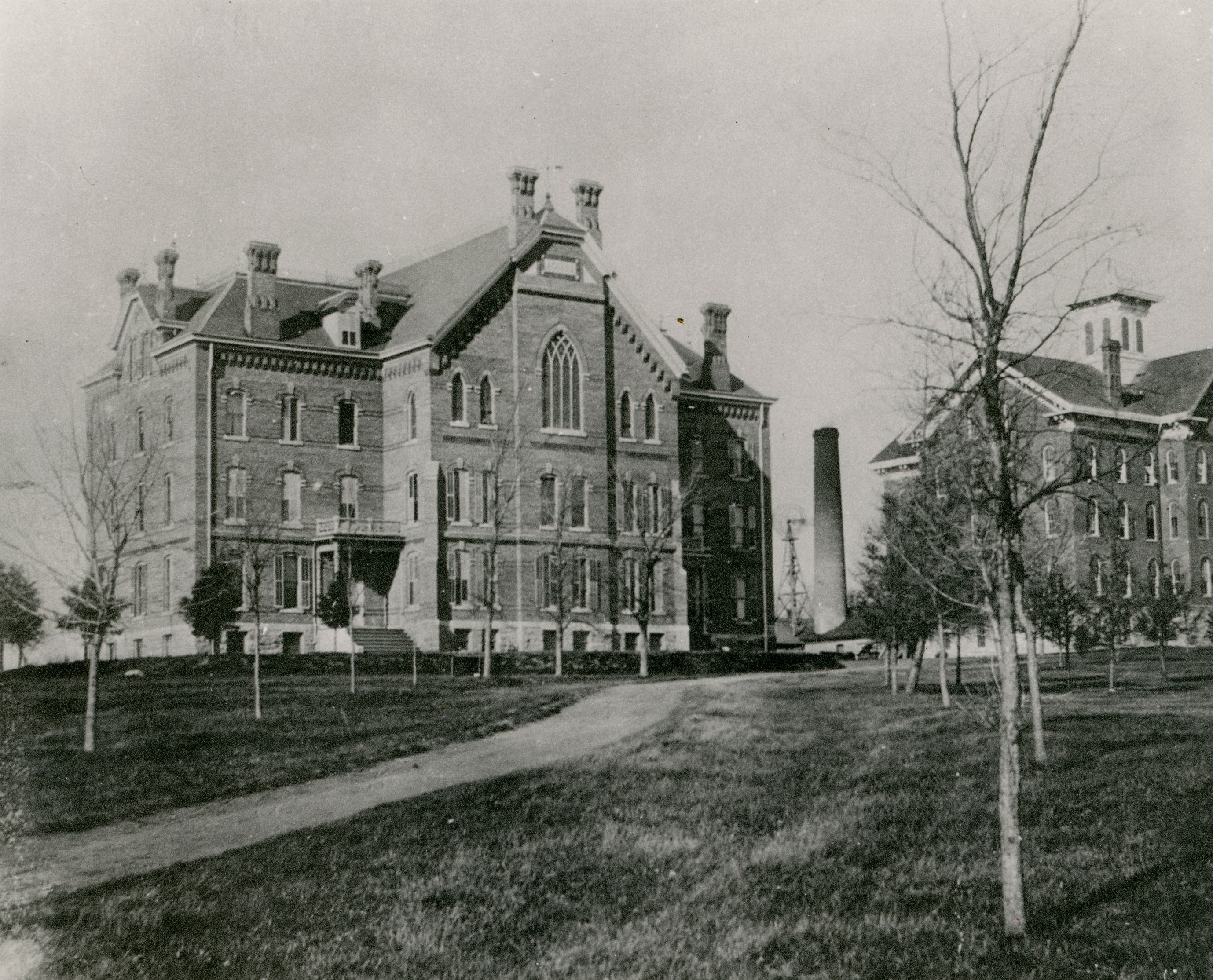
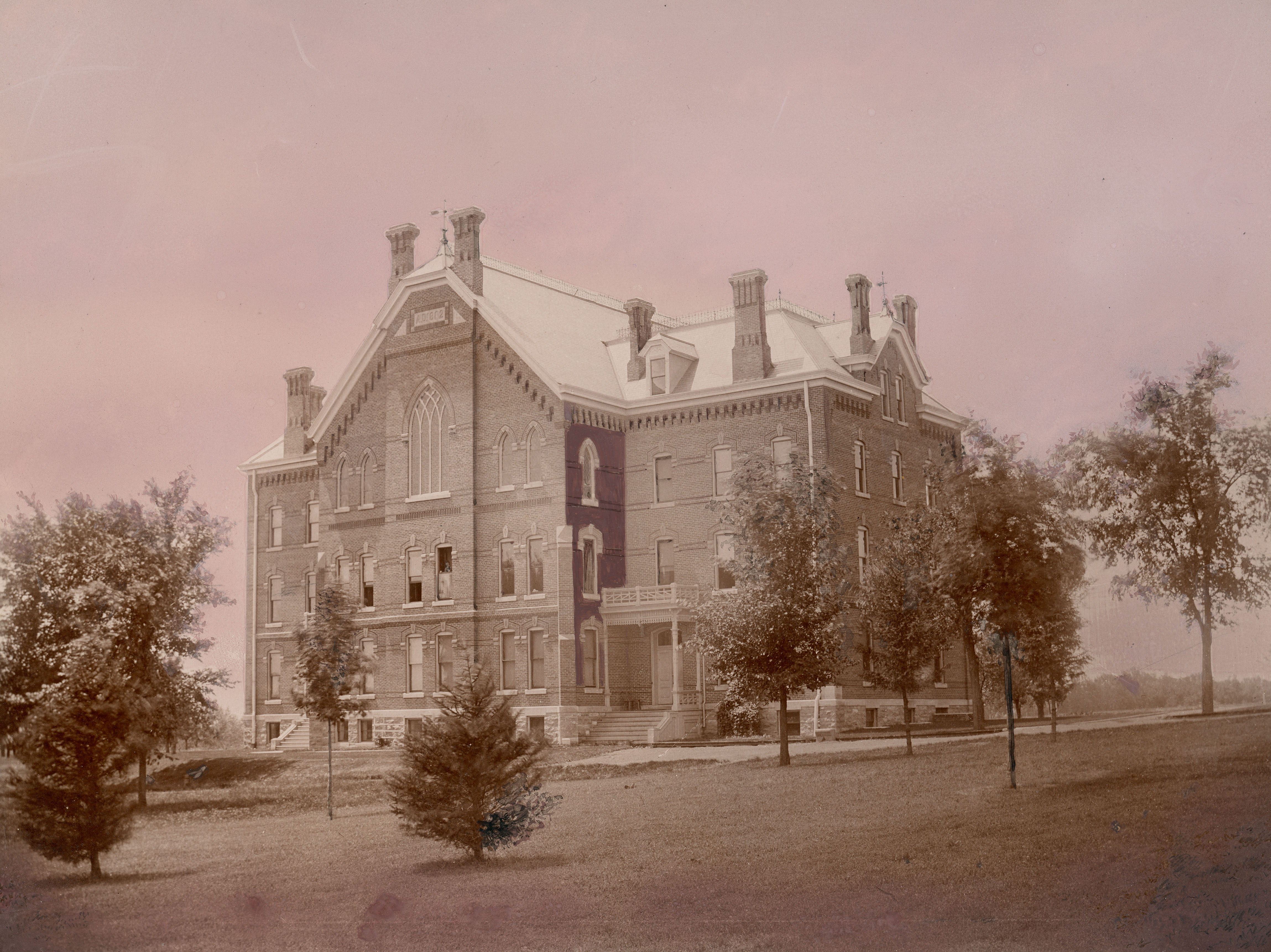
The Board awarded a $32,000 contract. Ground was broken on June 29, 1882 at a site about 100 feet south and a little east of the original Orphans Home building (today, just east of Maucker Union). Due to its location, its original name was South Hall. Spaces included a chapel capable of seating 700, a model schoolroom, classrooms, laboratories, a library, literary society halls, and an apartment for Principal Gilchrist and his family. It would steam heat, running water and gas lights. The cornerstone was laid on August 29, 1882.
The October 1882 issue of The Students' Offering reported the brickwork was complete above the second story. Workers used a horse-drawn elevator to hoist bricks and mortar to the upper levels. People from Cedar Falls would drive out to see the work in progress. In December 1882, the paper reported exterior brickwork was complete, with the exception of the gables and chimneys. The slate for the roof was on site and scheduled to be done by Christmas. Afterwards, the workers would concentrate on interior finish work.
By February 1883, about half the lathwork had been installed. A crew was also preparing to put in the heating pipes, which would run from the existing power plant. During that spring, the Board of Directors prepared for increased enrollment given the new facilities. Previously, the Normal School had to keep its enrollment low due to limited classroom and boarding space. In1880, enrollment was 233 students. With the new building, the Board believed the school could accommodate as many as 400 students. By March, the steam pipes had been installed and the heat was turned on. This enabled the plasterers to begin work. Gas pipes were in place. Speaking tubes had been inserted into the walls to connect various parts of the building with the Principal's office. By May, the chapel was complete except for the seating.
The building was dedicated on June 8, 1883. Governor Buren Sherman and Principal Gilchrist spoke at the dedication ceremony. During commencement on June 21, 1883, 16 orators from the Class of 1883 were the first to speak in the new chapel.
South Hall, the first building constructed on campus specifically designed for higher education, was ready for full use at the beginning of the fall term in September 1883. It had three stories plus an attic. Portions of the cellar were later excavated to provide additional space. The central portion measured 45 x 78 feet with two wings each measuring 43 x 32.5 feet. The chapel was 76 x 45 feet and could seat 700. The capacity of the model school room was 80. Other facilities included a library, chemical and physical laboratories, music rooms, offices, reception rooms, coat rooms, and six classrooms. Dormitory space and the Principal's apartment, located on the second floor of the south wing, occupied the rest of the space. The building was equipped with furniture worth over $1,000.

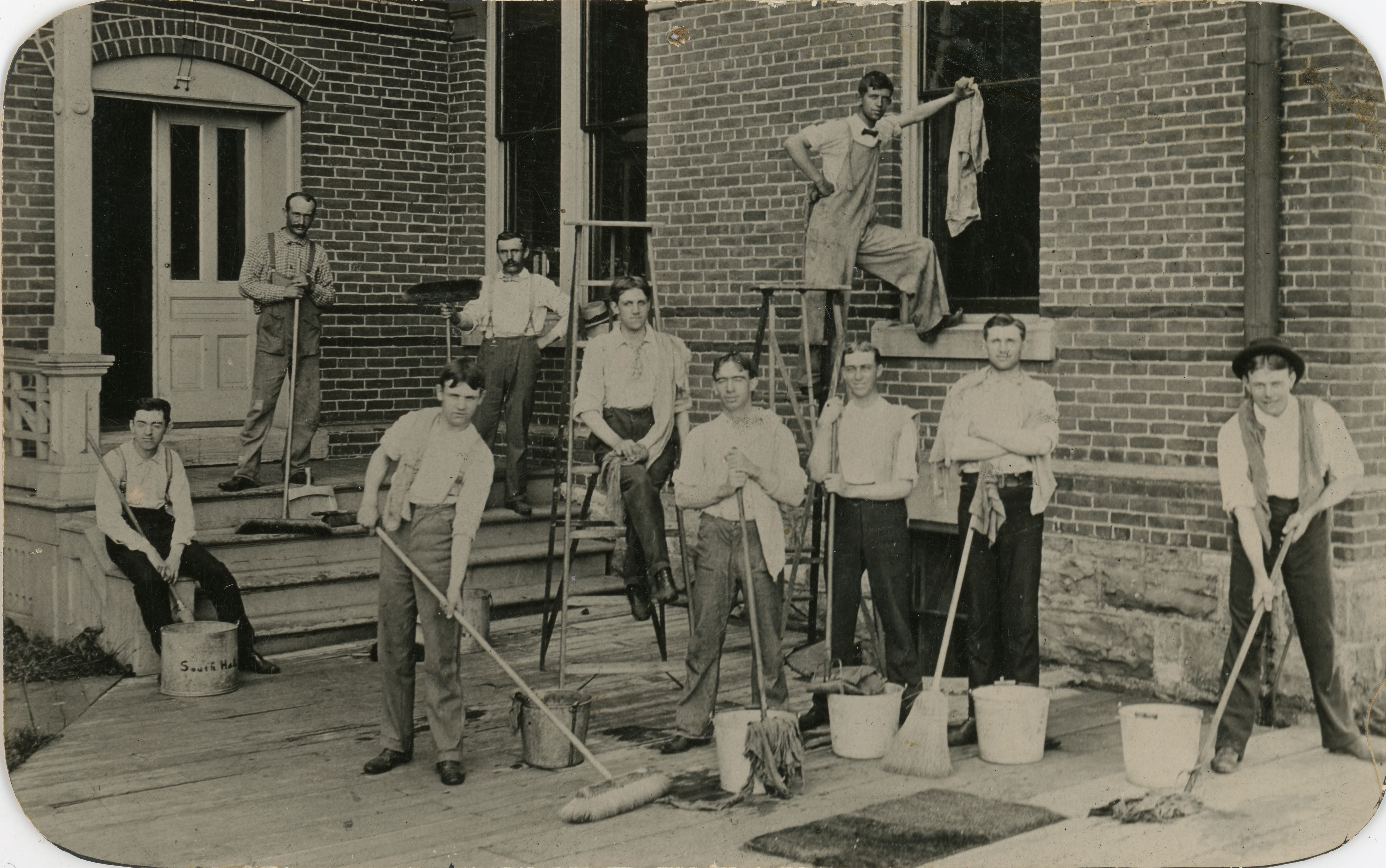
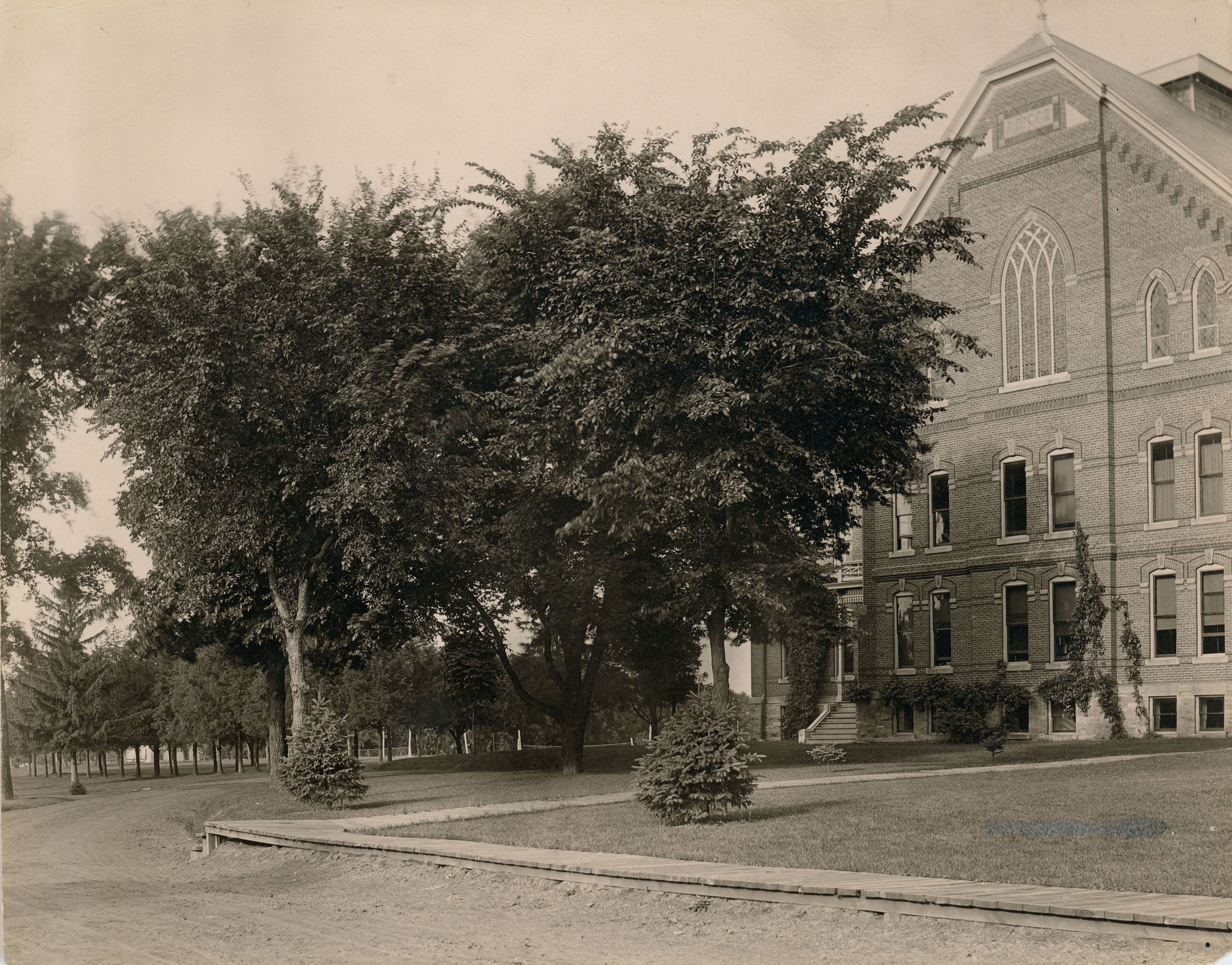
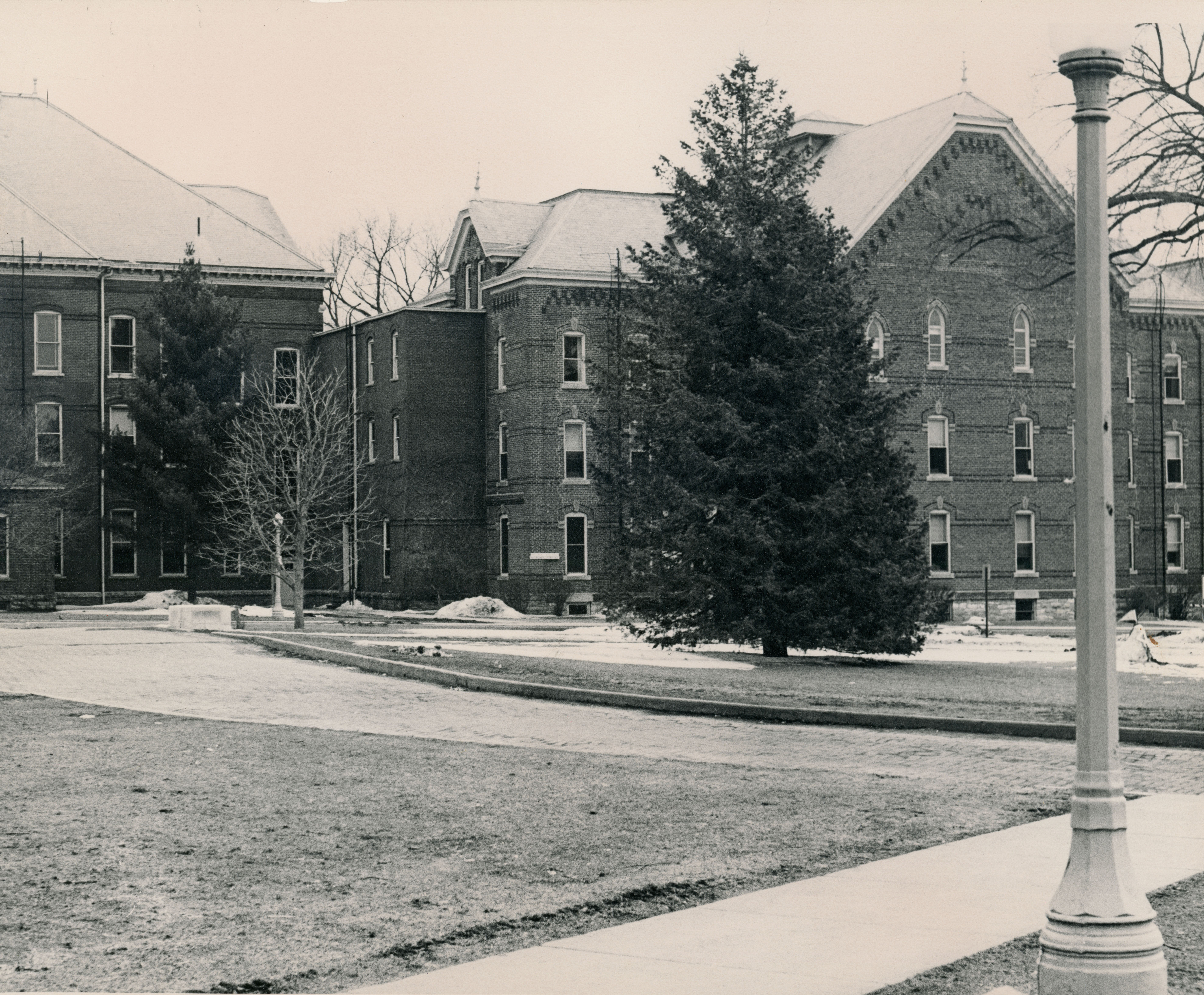
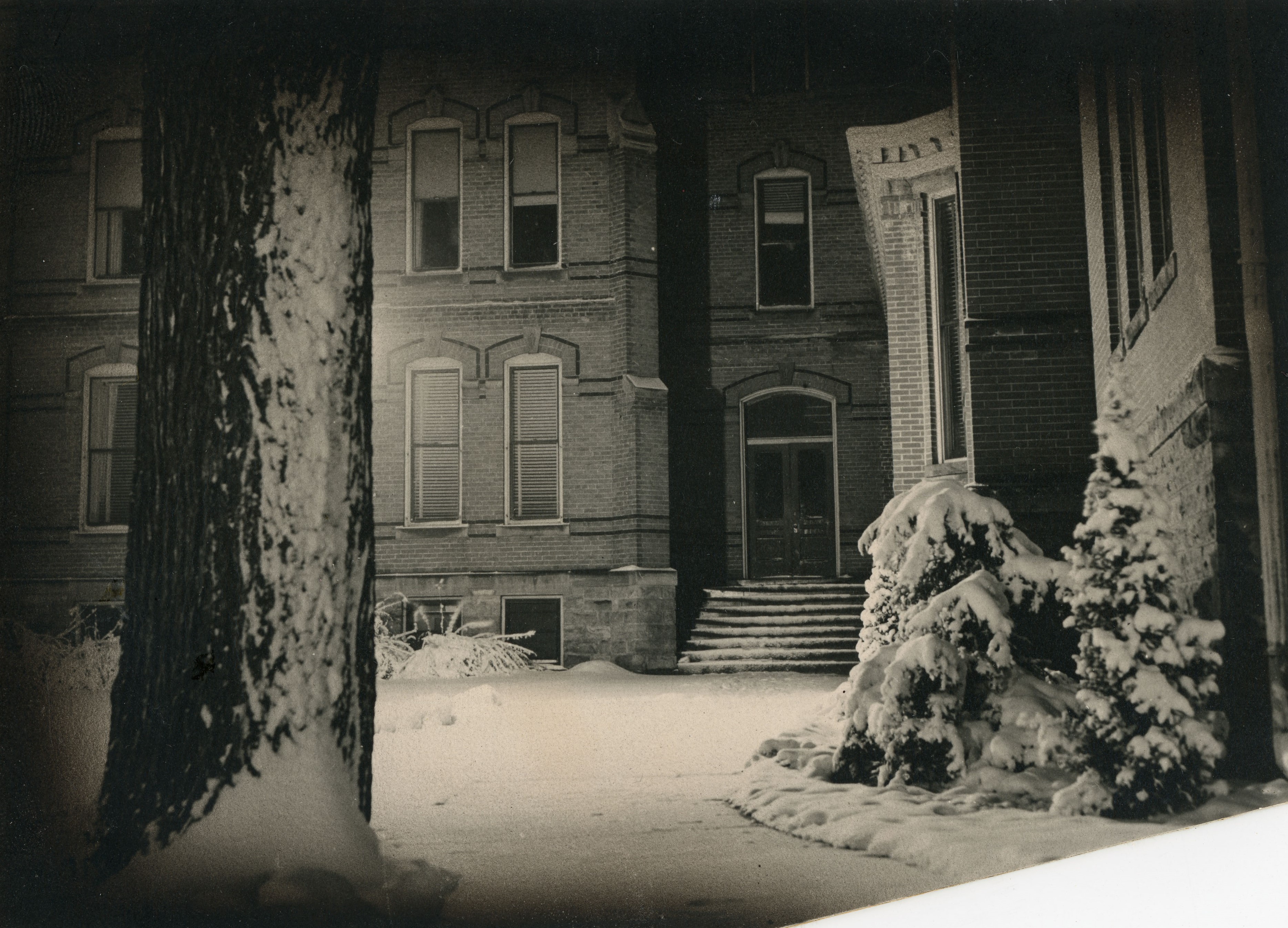
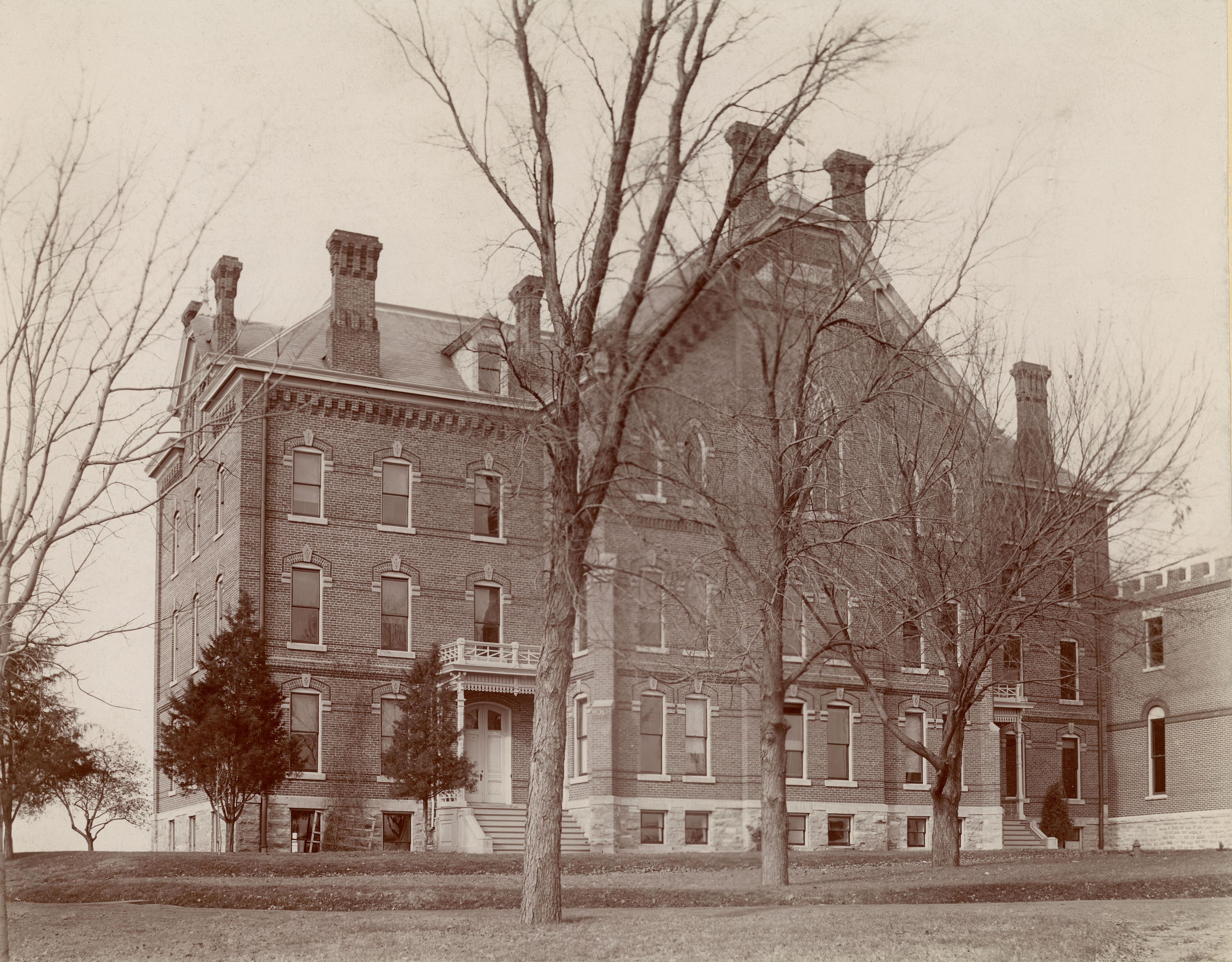

The library, a "spacious and pleasant" room, was located in the south wing of the first story. It contained about 1,800 volumes on all subjects. Books on pedagogy, or education, were highlighted, but there was also some fiction "by the best writers." In 1883, the school had begun to acquire books of its own, but many were from Principal Gilchrist’s personal library.
To help staff the new facilities, the Normal School hired two additional teachers: Maude Gilchrist, Principal Gilchrist’s daughter, would teach natural science and mathematics; Ella Ford Miller would teach the Model School, a precursor of the Laboratory School.
During the 1883-1884 school year, students and faculty contributed $332 to pay for frescoes and a chandelier in the chapel. Principal Gilchrist resigned in 1886 and was succeeded by President Homer Seerley, whose family continued to live in the South Hall apartment until the new President's Cottage, now known as the Honors Cottage, was completed in 1890.
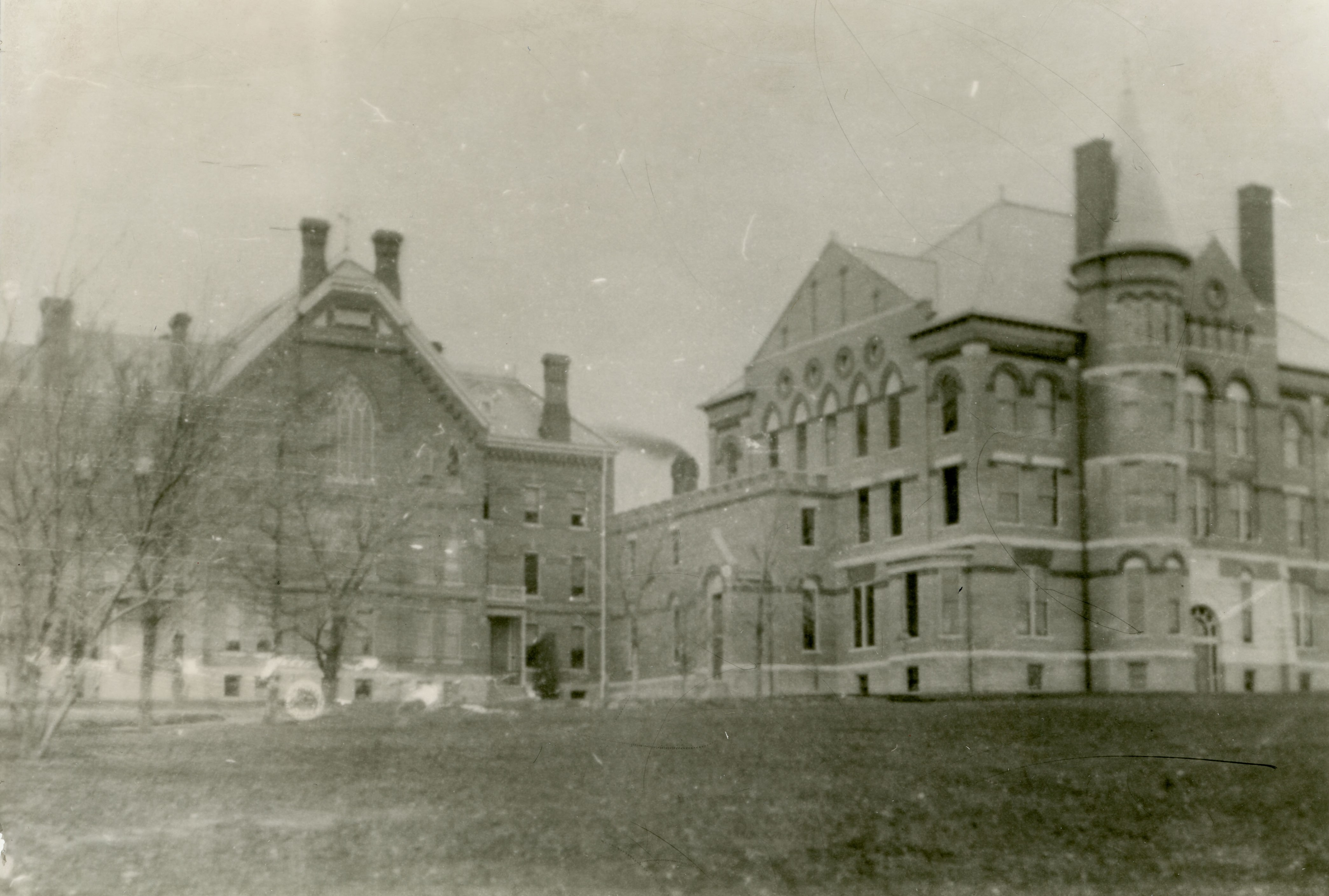
In 1892, the Normal School used a portion of South Hall to expand its nascent program in vocational education. A large basement room was set up as a carpenter's shop with benches and full sets of tools for both wood and metal work. It would be part of a third year class associated with the study of physics, where both women and men would learn basic carpentry skills. The Normal School Board also began discussion of building an elevated corridor between South Hall and North Hall to increase the efficiency of student passage at class change time. The bridge was built during the 1892-1893 school year. Several years later, South Hall was linked by a 10 foot wide, two-story corridor to the newly completed Administration Building. The corridor entrances to South Hall were at the north ends of the old north-south hallways in the building.

The school band began in South Hall in the 1890s. Jesse McLaughlin (Class of 1892), later recalled he hated military drill, which was compulsory for men during his time at the Normal School. To avoid attending drill, he suggested forming a Cadet Band. He found about 10 other men interested in the idea, but only a couple could play an instrument. President Seerley gave the group use of a basement room in South Hall to practice. The group hired a local barber to teach them how to play. Ultimately, they were able to march and play, although they could not do both at the same time, in the Memorial Day parade in 1890.
In 1896, South Hall’s ceiling was patched and the walls were repapered. In the spring of 1897, the two north chapel windows, which had been stained or colored glass, were replaced with clear glass to improve the lighting in the room. That fall President Seerley purchased a collection of reproductions of classic art and had them hung in the corridor between South Hall and the Administration Building. In 1898, the Board authorized installation of electric lighting in the chapel as well as additional work on the ceilings in South Hall. The new lighting was installed by the fall term. It consisted of "thirty-six incandescent lights of sixteen candlepower each . . . arranged on three circular reflectors suspended from the ceiling." The student newspaper commented that "They supply a long-felt need." It also significantly reduced the risk of fire.
Beginning in December 1901, main chapel assemblies were held in the new Auditorium Building, now known as Lang Hall. The South Hall chapel had become overcrowded as school enrollment grew, and only smaller divisions of the chapel meetings were held in South Hall. In 1904, in coordination with the construction of the new Gymnasium, the South Hall heating and ventilation system was re-fitted.
In 1915, South Hall received an official name when the State Board of Education chose to honor the first principal of the Iowa State Normal School, James Cleland Gilchrist. Principal Gilchrist served from 1876 to 1886 and lived in the building with his family for four years. Gilchrist Hall and Bartlett Hall were the first two campus buildings to be named in honor of people. Previously, buildings had functional or geographic names.
In 1919, two rooms on the east side of the second story of Gilchrist Hall were remodeled into meeting space for the faculty and the Faculty Club to meet. Larger meetings could still be held in the chapel. Likewise, the chapel could be used for musical and other performances which did not demand the seating capacity of the Auditorium. In 1923, the chapel was redecorated and a $2,500 grand piano was installed. The offices of both the College Eye student newspaper and the Old Gold yearbook moved from Central Hall to Gilchrist Hall in January 1924.

In 1929 and 1930, during President Orval Latham's changes to increase efficiency in college operations, office machine services were centralized in the basement of Gilchrist Hall. It housed photostat, mimeograph, and multigraph machines, as well as staff to operate them. A new concrete floor was laid in the area and the walls were plastered and painted. Two classrooms were also remodeled into a six-room suite for the new Dean of Women, Sadie B. Campbell. In addition, the Dean of Men moved from the Administration Building to Gilchrist Hall. President Latham also wanted to develop good public relations for the college. He outfitted the College Eye office to be more similar to a professional newspaper, and he created a new Public Relations office under the direction of George Holmes. Both offices were in remodeled quarters in Gilchrist Hall. Late in 1930, the Extension Service offices in Gilchrist Hall underwent major remodeling with new equipment, lighting, floor coverings and decoration. After this remodel, the basement of Gilchrist Hall held mimeograph and paper storage rooms. The first story had the offices of the deans, the Extension Service, and the News Bureau. The second story included music studios, the College Eye and the Old Gold offices, and the faculty rooms. The third story included more music studios and the chapel. In the south wing of the attic, there was a golf practice room.
In summer 1931, the News Bureau moved up to the second story, so it was in close proximity to the College Eye and Old Gold. College Secretary Benjamin Boardman moved into the space vacated by the New Bureau. His area included a new underground vault to store cash and important records. That fall, the Faculty Room received new drapes and carpet in a blue and gray color scheme.
The student publications area was changed again in 1934 with a new spatial layout, new offices and a door between the newspaper and yearbook offices to improve communications between the staff. There was also a new office for the Bureau of Alumni Affairs and a lounge with a kitchenette, and a dressing room for the secretarial staff. During this same period, the large parking lot west of Gilchrist Hall was removed and landscaped.
During summer 1935, the Gilchrist Hall chapel underwent a $6,000 renovation. Carpenters installed new, sloped flooring. A 24 x 16 foot stage with footlights, velour curtains, a proscenium, and stage doors on each side was built at the west end of the chapel. The pew-style seating was replaced by 294 upholstered opera-style seats. The remaining stained glass window on the east side of the chapel was replaced with clear glass. All the windows were hung with draperies. Two large ceiling fixtures and six wall fixtures provided light. The walls were replastered and painted an ivory cream color. The birch trim was stained dark. Panels were installed on the walls to improve acoustics. The project was completed shortly after Christmas 1935. Music students Eloise Harmon, Erma Brouhard, Esther Miller, Jane Eby and Frank Quinn performed the first recital in the small theater on January 9, 1936. The room continued to be called the Gilchrist Chapel, but was used mostly for debates, recitals and other kinds of performances.


In summer 1942, Gilchrist Hall was tuckpointed to repair deteriorated mortar. During the work, the tower and several of the tall chimneys were removed. In 1944, additional interior lights were installed in the building.
In 1947, President Malcolm Price outlined his plans for the future of the Teachers College, including the need for Gilchrist Hall, Central Hall and the Administration Building to be replaced. In 1948, the Business Office expanded its quarters in Gilchrist Hall. In 1950, the Extension Service received additional space in the building to sort and store its publications. In February 1954, the Faculty Room underwent renovation. The old pressed metal ceiling was removed, drapes were installed, and the room was painted. In addition to serving as the site of faculty meetings, it also served as headquarters for debate tournaments, local conventions and occasional social gatherings.
Also in 1954, an editorial writer in the College Eye called Gilchrist Hall, along with the Auditorium and the Administration Buildings, "old and unworthy of habitation." In 1956, Registrar Marshall Beard indicated Gilchrist Hall was slated for removal. In the meantime, the building continued to house offices, services, and programs including the Business Office, the offices of the Deans of Women and Men, the Old Gold office, the College Eye office, public relations, music practice rooms, and the college archives.
In February 1962, the new Music Building, now known as Russell Hall, opened. Music offices and practice rooms moved from Gilchrist Hall to the new building. Faculty from the Department of Education and Psychology moved into the vacated space. One room would be used as a Public Relations photography lab.

On July 22, 1965, a fire destroyed Central Hall. Reflecting on campus landmarks, an editorial titled “Tradition–worth the effort?” was published in the College Eye on November 16, 1965. The writer said: "Before curtly dismissing Gilchrist Hall as an architectural monstrosity, a campus blot, and bulldozing it over, it would be wise to consider--if only briefly--its value as a symbol. Despite its unfortunate location and condition, it remains as SCI's best symbol of the continuity of past, present, and future, a symbol of solidarity. It is a sign of what this school has been, the progress that it has made; it is assurance that this college has served well in the past and will continue to serve well in the future. But to suggest salvaging Gilchrist and Administration is bucking a strong current ...."
On March 19, 1967, a group of students working in the College Eye office in Gilchrist Hall smelled smoke. They looked around the office area with the help of a campus security officer, but could not identify the source until a student felt a drop of liquid hit him on the head. The cause was a shorted light fixture transformer whose wax seal had begun to melt. They switched off the light to prevent a fire.
In summer 1969, the chapel was converted into a large lecture hall. Cuts in the university's budget later that year delayed the funding of new construction and indicated Gilchrist Hall could not be razed until 1982.
On May 12, 1972, faulty electrical wiring in Gilchrist Hall caused a fire that destroyed much of the building. Students and faculty saved some equipment and materials before the fire intensified. At the time, the Educational Center, a planetarium, Behavioral Research Psychology Laboratory, Department of Curriculum and Instruction, and seventeen faculty offices were located there. The newly-constructed planetarium was completely destroyed. The Media Center lost television equipment, but salvaged other audio-visual equipment and most of its film collection. Professor Gordon Harrington lost equipment and data from his laboratory, and faculty members lost the contents of their offices.


In June 1972, the Regents approved UNI's request to set the fire loss at $1,095,525 and awarded a $31,910 demolition contract. They also passed a resolution of thanks to students and faculty who voluntarily attempted to save books and equipment from the fire.
On September 3, 1972, as a crew was razing the building, workers discovered the 1882 cornerstone with a metal box inside. There was a formal ceremony to open the box on October 7, 1972. It opened with a carillon concert. Alumni Director Lee Miller introduced 15 descendants of Principal Gilchrist, the building’s namesake. Professor William C. Lang talked about the historical background of the building and the university. Then, since members of the Masonic order had originally laid the cornerstone, current members of the order opened the box. Sealed inside were items from the school's early days. Included were Normal School catalogs, reports, the library catalog, rules and regulations, and a copy of the bill which established the Normal School in 1876. The Gilchrist Hall cornerstone contents are preserved in the Rod Library Special Collections and University Archives. Following the ceremony, other historical memorabilia salvaged from the building, including dishes, keystones, and capstones were sold at auction.


Compiled by Library Assistant Susan Witthoft; edited by University Archivist Gerald L. Peterson, Special Collections and University Archives, July 1996; substantially revised by Gerald L. Peterson, with scanning by Library Assistant David Glime, August 2006; updated July 28, 2015 (GP); photos and captions updated by Graduate Assistant Eliza Mussmann February 8, 2023; copyedited by Student Assistant Sara Shannon, December 2025; updated by Library Assistant Hannah Bernhard, March 2026.